Blog · 26 September 2026 · 5 min read
Blocked Toilet and No Plunger: What to Do
Short answer: stop flushing, then try hot (not boiling) water with a good squeeze of washing-up liquid and wait 20 to 30 minutes. If the level does not drop, a straightened wire hanger can reach a blockage close to the bowl, and a cut plastic bottle can work as a makeshift plunger. If none of that works, the blockage is further down and needs a drain snake.
Most blocked toilets are caused by too much paper at once or by things that should not be flushed — wet wipes above all. Old Lisbon buildings, with narrow and fairly flat waste pipes, are less forgiving than new ones.
First: stop the water rising
Do not flush again. If the bowl is already full, another flush will send dirty water over the rim.
Close the small isolation valve on the pipe that feeds the cistern (behind or beside the toilet). If you cannot find it, lift the cistern lid and hold the float up so it stops refilling.
Put old towels around the base of the toilet, and move anything on the floor that you do not want to get wet.
Method 1: washing-up liquid and hot water
Squeeze a generous amount of washing-up liquid into the bowl. Let it sink for a few minutes — it lubricates the blockage and helps paper slide.
Then pour a bucket of hot tap water from waist height. The weight of the water adds pressure. Wait 20 to 30 minutes.
Never use boiling water: the sudden heat can crack the porcelain, and a cracked toilet is a much bigger problem than a blocked one.
Method 2: a makeshift plunger
A plastic bottle with the bottom cut off makes a simple plunger: push the open end into the outlet, cover the neck with your thumb and pump firmly.
Keep the water level low enough to avoid splashing, and wear gloves. Short, firm pushes work better than long strokes.
Method 3: a wire hanger
Straighten a wire coat hanger, keep a small hook at the end, and wrap the tip in a cloth or tape so it does not scratch the porcelain.
Push gently into the outlet with a twisting motion. It only reaches the first bend of the toilet, but that is where many blockages — a lump of paper, a toy, a cotton bud — get stuck.
What not to do
No chemical drain cleaners. They rarely clear a real toilet blockage, they sit in the bowl, they can damage old pipes and seals, and they make the job dangerous for whoever clears it afterwards. More in why plumbers avoid chemical drain cleaners.
Do not push in objects you cannot pull back out, and do not flush "to see if it moved" until the level has gone down on its own.
Signs the blockage is further down
Water rises in the shower or bath when you flush. Other drains gurgle. The toilet empties very slowly even when nothing is visible. Several flats in the building have problems at the same time.
These mean the blockage is past your toilet — in your flat's waste pipe or in the building's shared column. Home methods will not reach it. A drain snake or jetting is needed, and if it is the shared column it is usually a matter for the condominium. See blocked toilets and who pays for a blocked building drain.
How to stop it happening again
Only toilet paper goes in the toilet. No wipes (even "flushable"), cotton buds, sanitary products, dental floss, kitchen paper or cat litter. See are flushable wipes really flushable.
In older buildings, flush halfway through if you use a lot of paper.
If the toilet blocks repeatedly, something in the pipe is catching waste. A camera survey finds it.
Which plunger to buy for next time
There are two shapes. A flat cup plunger is for sinks and showers. A flange plunger — a cup with an extra rubber sleeve underneath — is made for toilets: the sleeve fits into the outlet and seals properly.
If you only buy one, buy a flange plunger: it also works on flat drains by folding the flange up. Keep it in the bathroom.
Using a plunger properly
There must be enough water in the bowl to cover the cup. Push down slowly first to push the air out, then pump firmly up and down 10 to 15 times while keeping the seal, and pull away sharply. Repeat a few rounds before giving up.
Most failures come from a poor seal or from giving up after two pushes.
Toilet augers: the next step
A toilet auger is a short, crank-operated snake with a protective sleeve so it does not scratch the bowl. It reaches past the first bends and can grab wipes or break up a blockage. They are sold in hardware shops.
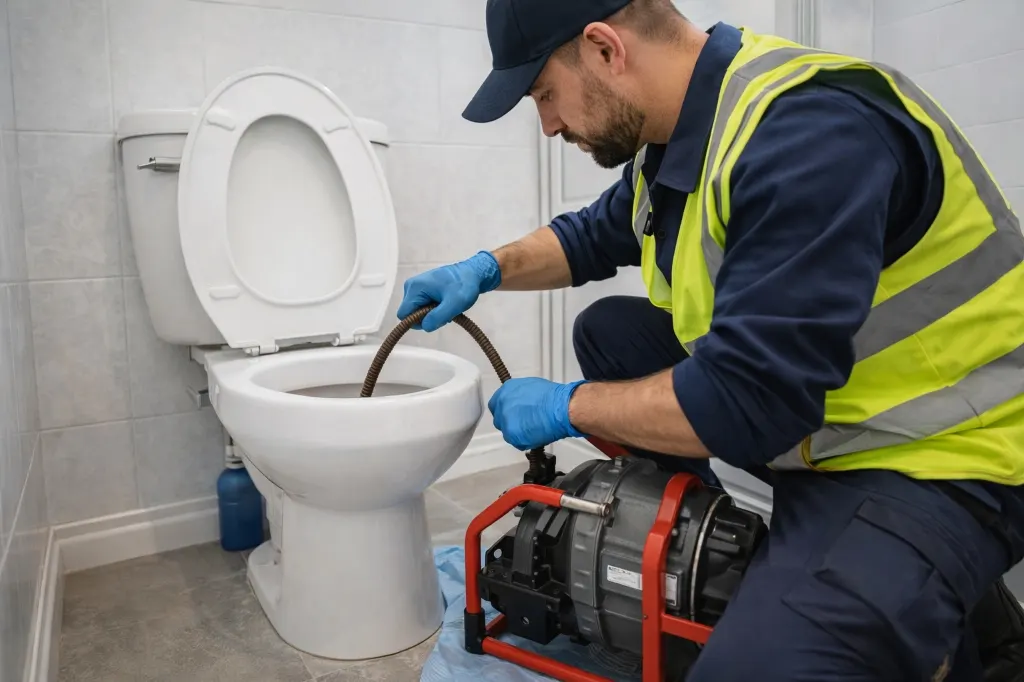
If an auger does not clear it, the blockage is past the toilet — in the flat's waste pipe or the building column — and needs professional equipment.
Macerator toilets (sanitrit)
Some flats have a toilet connected to a macerator pump — you hear a motor after flushing. These must never receive anything but toilet paper: wipes and sanitary products jam the blades. If a macerator stops or keeps running, switch it off and call a professional; do not plunge it.
Still blocked? We clear it without removing the toilet, from 75 €.
Blocked toilet in LisbonFrequently asked questions
Will a blocked toilet clear by itself?
Sometimes, if it is only paper — the water slowly softens it. Wipes, cotton buds and sanitary products will not break down.
Can I use a toilet brush as a plunger?
It can push a soft blockage a little, but it is not effective and splashes. A cut plastic bottle works better.
Why does my toilet keep blocking?
Usually wipes, too much paper for narrow old pipes, or a problem further down such as a sag or build-up. Repeat blockages are worth a camera survey.
Is it safe to use bleach on a blocked toilet?
Bleach does not dissolve blockages. Never mix it with other products — some combinations release toxic gases.
How much does it cost to unblock a toilet?
With us, from 75 €. The price is confirmed before we start.
The toilet cleared but empties slowly.
There is still a partial blockage further down. It usually returns — worth clearing properly.

Services Lisbon plumbing team
Guides written by the plumbers who do this work in Lisbon homes every week — drains, leaks, water heaters and pipework.